

Synnovis
Synnovis supports development to dramatically reduce pre-transfusion testing times for myeloma patients
Validation work undertaken by Synnovis Biomedical Scientist, Molly Rutherford, has the potential to significantly improve the blood transfusion experience for patients receiving daratumumab, a treatment widely used for multiple myeloma.
Multiple myeloma is the second most common blood cancer worldwide. Although it remains incurable, major advances in treatment have significantly improved patient outcomes, particularly following the introduction of Daratumumab. Anaemia is a common complication of multiple myeloma, making blood transfusion an important part of patient care. However, Daratumumab interferes with tests required prior to transfusions that ensure the blood received is compatible with the patient. It can produce false positive reactions that make it difficult to identify genuine antibodies and compatible blood components.
As a result, specialist testing is required to overcome this interference, meaning the compatibility process can take 24-48 hours to complete. For patients, this means long and often overnight hospital stays.
Molly’s innovative work has focused on a pioneering new solution that could significantly reduce the time to identify compatible blood.
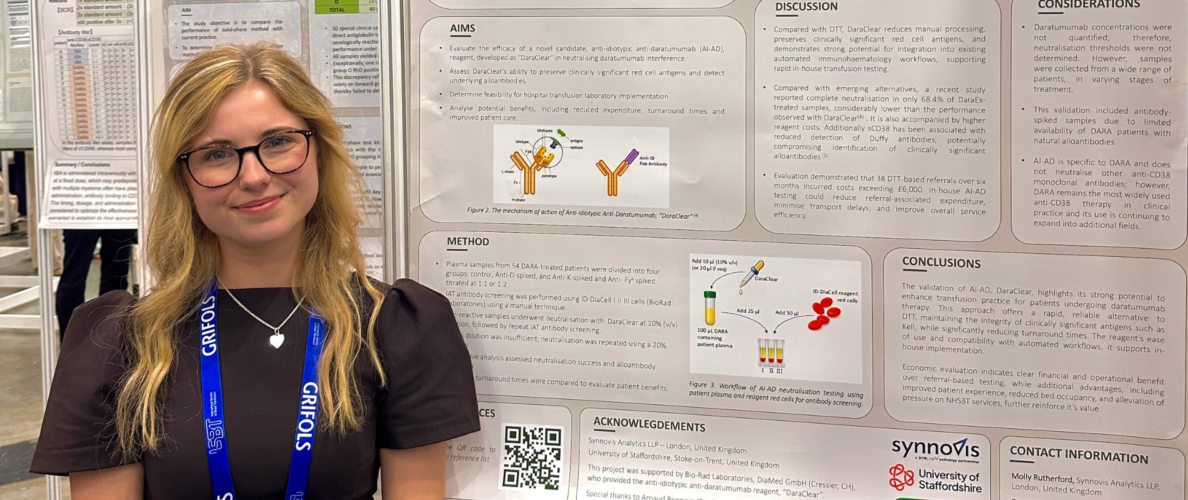
As part of her final year project of her Healthcare Degree Apprenticeship with Synnovis and the University of Staffordshire, Molly has been validating a new reagent developed by Bio-Rad called “DaraClear”. The reagent is designed to neutralise the interference caused by Daratumumab during pre-transfusion testing, with the potential to allow compatibility testing to be performed more rapidly within hospital transfusion laboratories.
In June, Molly presented her findings at the International Society of Blood Transfusion (ISBT) Congress in Kuala Lumpur.
Molly said: “It was a privilege to present our work on a possible solution for interferences in pre-transfusion testing to colleagues from around the world, all of whom are working on such exciting developments in transfusion medicine.
“With Daratumumab increasingly being trialled for use in other blood and immune system-related conditions, I am excited to see this work translated into routine practice.
“The next steps are further validation using our automated platforms and titration studies to build the evidence for wider implementation, with the ultimate aim of reducing delays and improving the patient experience.”
The findings from this study contribute to a growing body of evidence supporting DaraClear as a potential solution to Daratumumab interference in pre-transfusion testing. If implemented into routine practice, the reagent has the potential to transform transfusion experience for patients receiving the treatment.
We are incredibly proud of Molly for sharing her important work on the world stage and contributing to innovation in haematology.